
Leaks after assembly are often attributed to the gasket itself. But in the same single-sided groove, replacing the gasket, adjusting hardness, and increasing compression all failed to eliminate the leak — the gasket was never the issue.
The gasket was only half constrained
With one grooved face and one flat face, only the lower half of the gasket is retained by the groove wall. Under clamping load, the upper half has no lateral constraint and can be extruded over the groove edge or roll over entirely. Once rollover occurs, compression deviates from the design value; without correct compression, the seal cannot function.
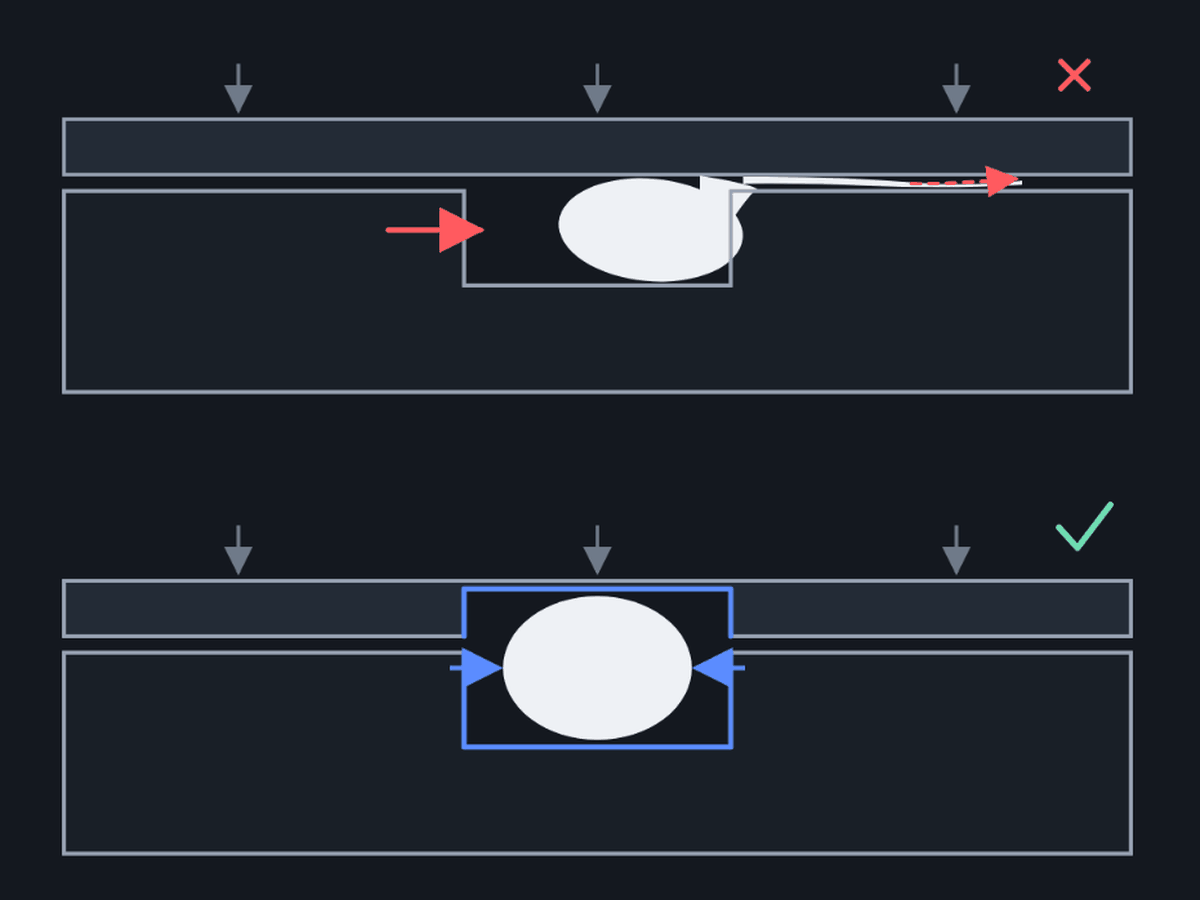
Add a second groove
The solution is not further gasket adjustment, but adding a groove to the opposing face. When the two grooves are aligned, the full gasket cross-section is enclosed by groove walls, leaving no room for movement under compression. A single additional groove makes the seal effective.
Changing the groove costs less
Most seal failures are not gasket failures; the groove did not properly constrain the gasket. Changing the groove is also the lower-cost path: replacing the gasket requires re-selection, re-validation, and new samples, whereas a groove change is a one-time structural correction.
For groove geometry and compression values, please contact us to discuss.