
The customer operates an 18 m-class aerial work platform on a blue-plate chassis (China's light-truck category, with a hard cap on gross vehicle weight). The requirement: a working height above 26 m.
With steel, the two requirements cannot both be met. The boom is a cantilever: bending moment grows with the square of its length, while self-weight grows linearly, and self-weight is itself deducted from payload. Adding material does not buy height.
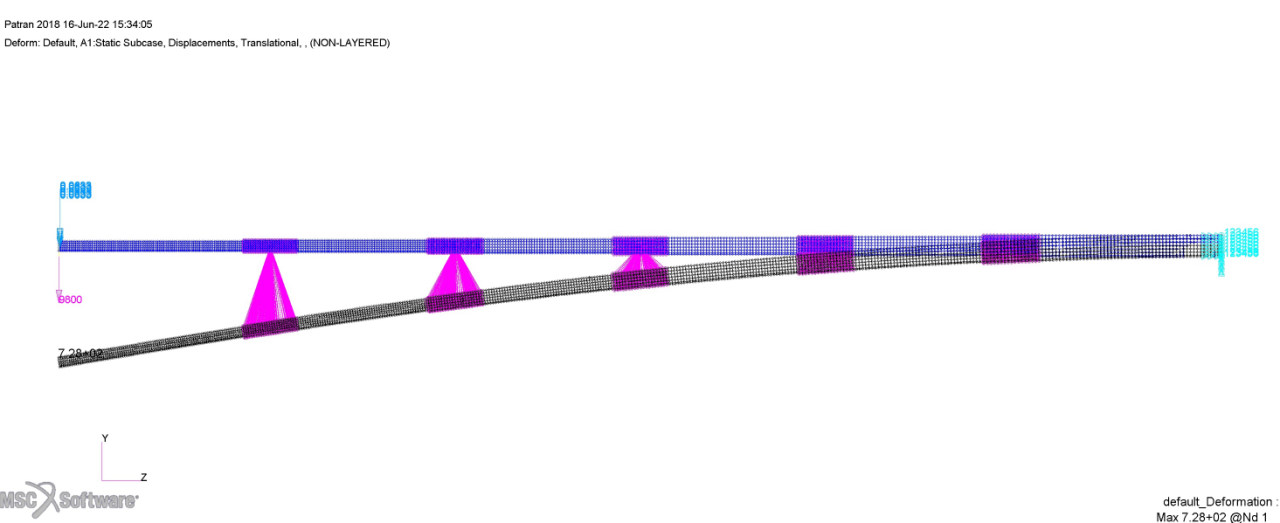
The original boom: six manganese-steel sections, 728 mm maximum deflection, 223 MPa maximum stress at rated load.
Approach
A pure composite boom does not work either. Bearing strength and wear resistance at the pin bores fall well short of those of steel, and the boom joints cannot carry the load.
The final design uses eight sections with a U-shaped cross-section. At the same section depth, a U-section bends more efficiently and leaves room to seat wear pads between sections.
Material is graded to the bending moment: high-strength steel at the root; carbon fibre and high-strength steel together through the middle sections; and pure carbon fibre in the smallest tip section. Bending moment falls from root to tip, and material strength falls with it, so the most expensive material sits only where the load is lowest.
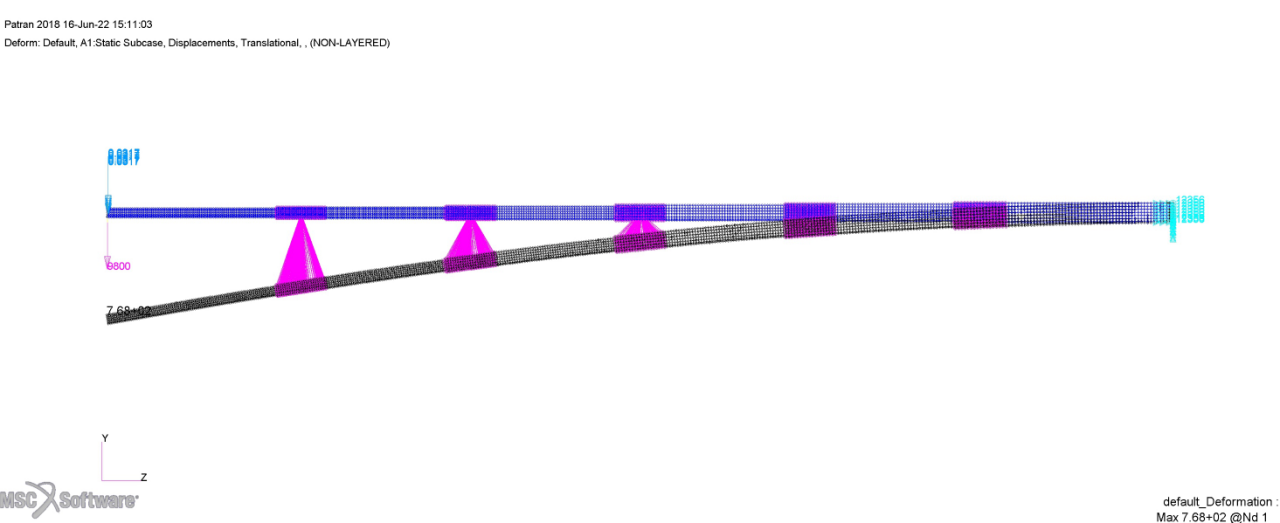
The first build kept the original six sections and changed only the material.
Verification and Iteration
The first strength check was done by an intern, and the result looked unusually good: he believed the boom could reach 40 m. At the design review, a colleague pointed out that the check had omitted the boom's own weight. In a cantilever, that is fatal — self-weight is a primary source of bending moment, so omitting it is equivalent to counting the largest load as zero.
Iteration followed: new forming processes, adjusted steel wall thickness, different carbon fibre grades, and a fresh strength check on every version, with the customer involved throughout.
Results
Six-section steel-carbon hybrid, boom length unchanged at 22 m: deflection rose from 728 mm to 768 mm, just 40 mm more, for 300 kg less weight.
Eight-section, 29 m boom: maximum stress 333 MPa, maximum deflection 1460 mm, meeting GB 25849-2010.
Two more sections take the boom from 22 m to 29 m, a 32% increase, and lift the machine from the 18 m class to a working height above 26 m. The boom still weighs 100 kg less than the original six-section steel boom. The two added sections cost 200 kg.
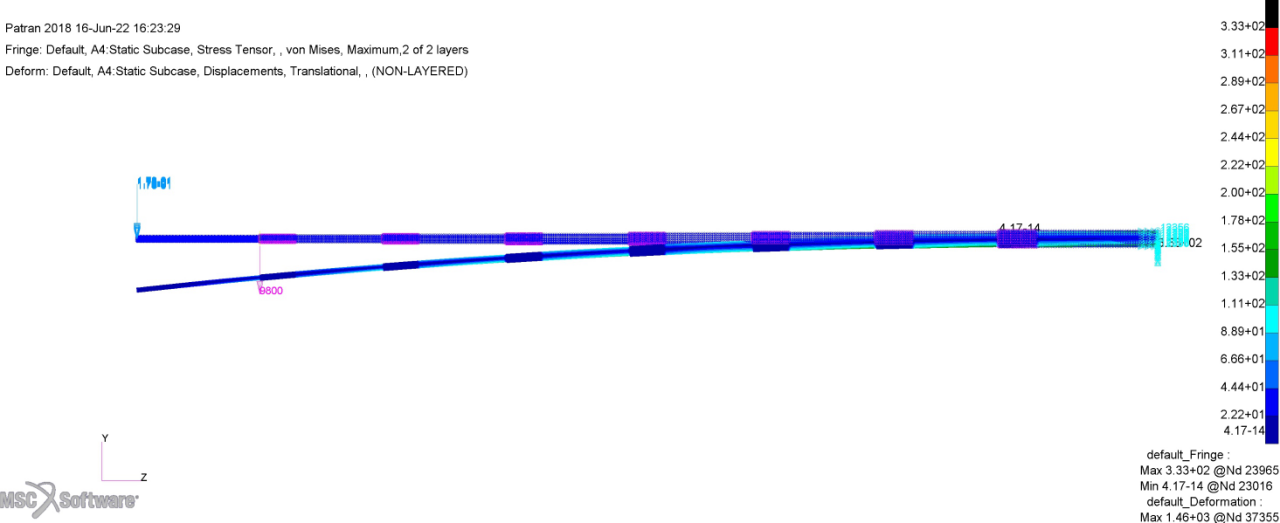
Doubling the deflection was unavoidable at that length. It remains within the deflection the standard allows.