
The customer's machine is a tracked mobile robot, 55 kg all-up, roughly 40 × 60 cm. After some time in service, three problems appeared together: the upper housing dented when someone stood on it; the plastic housing warped; the IP67 seal failed and water got in.
They looked like three separate faults. All three trace back to one root cause: a large, thin-walled plastic housing that is not stiff enough.
Water ingress is a stiffness problem before it is a gasket problem
IP67 depends on the sealing faces staying in contact. They stay in contact only if the panel remains flat, and the panel remains flat only if the structure is stiff enough.
With plastics, the cheapest way to add stiffness is to thicken the wall — and on this machine, thickness adds weight exactly where weight is least wanted.
Once the panel deflects, the sealing face no longer sits where it was designed to be, and gasket compression is no longer the calculated value. The leak was not a gasket failure; it was a stiffness failure. Warping and crushing are the same shortfall showing up in different forms.
The standing load has no fixed position
Easy to miss on this part: the standing load is neither fixed nor centered. One person at 80 kg, standing anywhere, on roughly two shoe soles. The robot travels at 1 m/s, peaking at 2 m/s, over potholes and ramps. The simulation used a 120 kg point load — 1.5× — with no preset position.
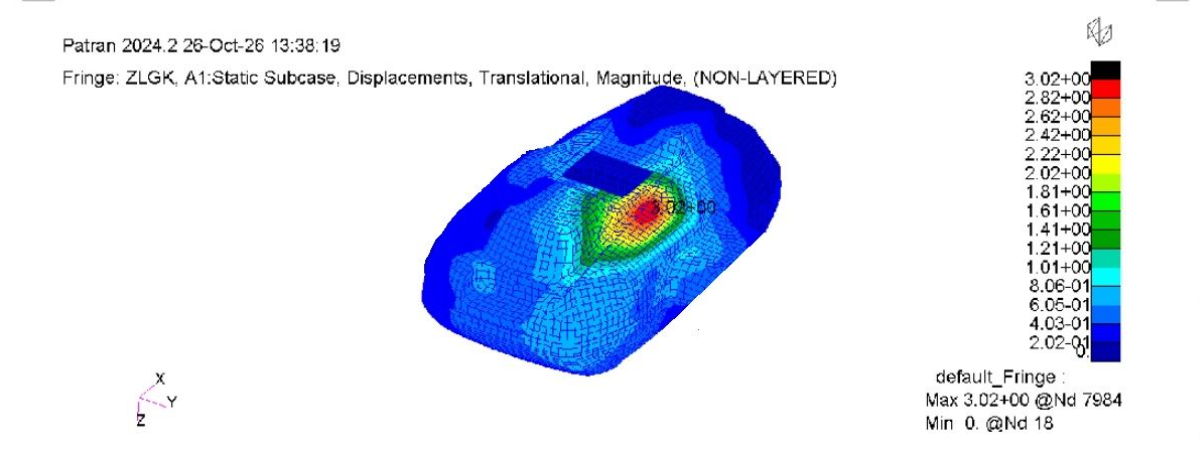
No specification sheet says "someone will stand on it." The real trigger is often a casual action on site, never recorded, and it determines how the part has to be designed.
The fix: new material, and a new structure
Changing the material alone does not solve it. Composites have higher specific stiffness than plastics, so stiffness no longer has to be bought with thickness — that is the material half. The other half is structure: not copying the plastic part in composite, but re-laying it out around how composites actually behave.
Ribs or a metal liner would also restore stiffness, at the cost of an extra process step, a set of fasteners, and the weight coming back. The value of the composite is that stiffness is built into the wall itself, formed in one shot, with no added parts.
Thickest section of the upper housing: 20 mm down to 16 mm — 4 mm thinner, yet stiffer.
Result
Machine weight: 55 kg down to 35 kg, 20 kg less, a 36% reduction. The housing withstands foot traffic without denting, holds its shape, and IP67 holds.
For parts like this, the criterion is simple: if a part must be IP67-rated, cosmetically flat, crush-resistant, and light at the same time, it probably should not start as plastic.