
The customer's RF transmission requirement read “95% to 99%, the higher the better,” but named no single threshold.
Our initial design was clean: cyanate ester resin with glass fibre, 0.5 mm wall. A flat coupon measured 97% transmission across 2.4–8 GHz in customer testing. Light, cost-effective, and every figure within range.
Halfway through the presentation, the real problem surfaced.
A coupon does not take that hit for the product
The RF-transparent face sits on top of the machine; the battery sits underneath. To change the battery, the operator turns the whole machine over so that face rests directly on the ground — and not gently: the machine is dragged across concrete. The previous housing was 2.5 mm PA6 and survived that use. A 0.5 mm glass-fibre shell, used this way, would not last many cycles.
The coupon was not wrong. A coupon simply does not take that hit for the product.
No datasheet says, “this face gets dragged on the ground.” The customer did not mention it; we did not ask.
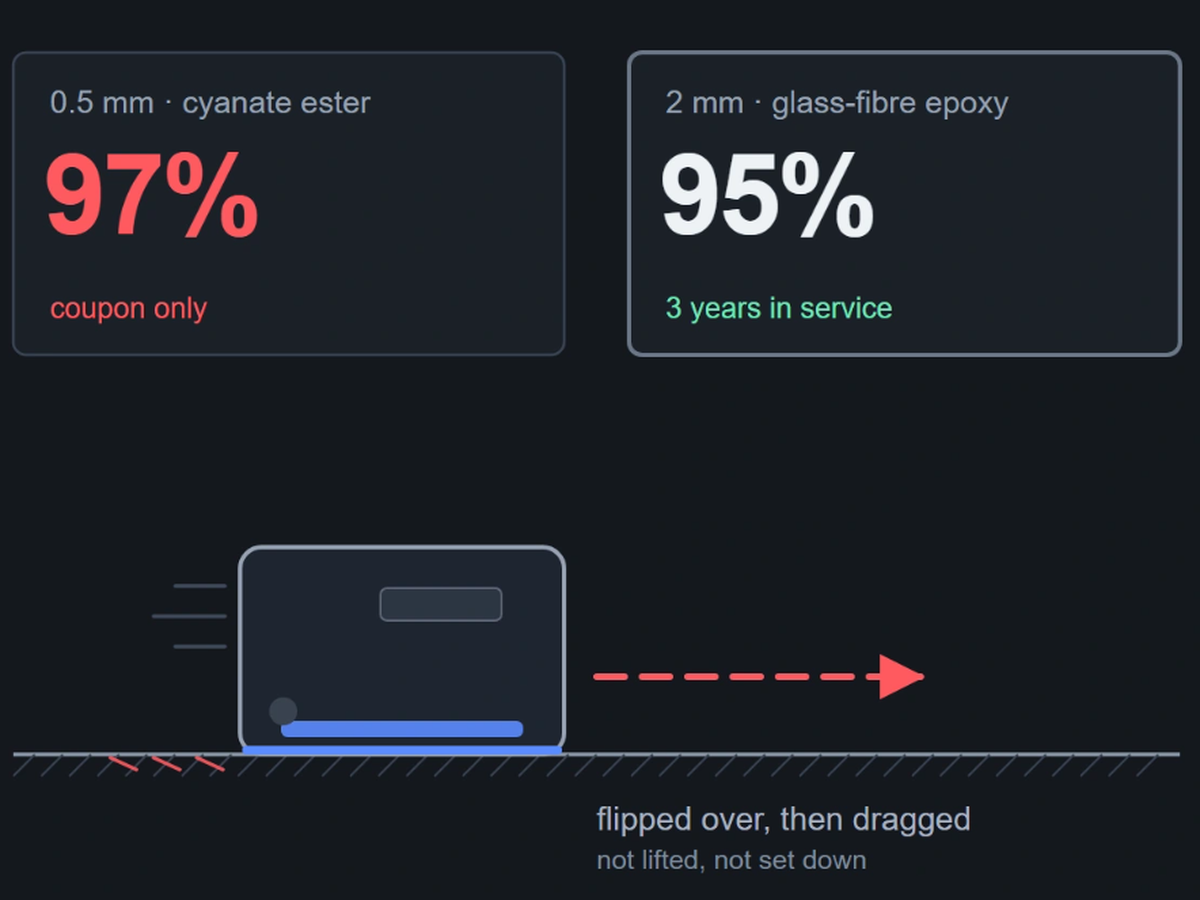
Back to 2 mm, and the spec comes down
The design changed: 2 mm glass fibre with epoxy, ≥95% transmission in the same band, customer-tested. A thicker wall required one grade down in material — cyanate ester to epoxy — and total cost, including tooling and testing, came out about 30% below the 0.5 mm design. A few hundred grams heavier, still within the machine's allowable range. Three years in service, no problems.
Those two points
We had spent effort pushing 95% to 97%, only to find those two points were worth nothing from the start. What decided the design was not the number but an action nobody had written into the specification: turn the machine over and drag it across the floor.
Now we ask three questions before any design discussion: Where does this part sit? Who touches it? How do they touch it?
The specification tells you what a part has to meet. The use case tells you what it has to survive.